
CYTO U Webinar: Beyond Bulk Immunity: Dissecting Antigen Specific B & T Cell Responses Across Species
Tuesday, March 10, 2026 (12:00 PM - 1:00 PM) (EDT)
Description
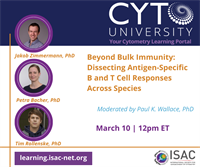
WEBINAR SUMMARY The key determining feature of adaptive lymphocyte is their antigen specificity. Yet, identification of the B and T cells specifically involved in an immune reaction is often not trivial and analysis is frequently limited to bulk populations. To distinguish specifically engaged lymphocytes from potentially confounding bystander cells and understand their contribution to immunity, it is paramount to unequivocally identify and characterise them on the single-cell level. In the webinar we will cover the most up-to-date methods for identification and characterisation of antigen-specific lymphocytes including human and mouse B and T cells. Learning Objectives: Participants will walk away with an understanding of: Who Should Attend: Research Scientists, Trainees (graduate students, postdocs, early career researchers), Translational Immunologists, and/or Any immunologist working on B or T cells (mouse and human but also other organisms) THE SPEAKERS Dr. Jakob Zimmermann, Dr. Jakob Zimmermann studied Molecular Medicine at the University of Freiburg, Germany. He obtained his PhD in 2015 at the German Rheumatism Research Center (DRFZ) and the Humboldt University, Berlin with summa cum laude honors. From 2016 to 2023, he conducted postdoctoral research at the University of Bern, Switzerland, supported by a Marie Skłodowska-Curie Fellowship of the European Commission. In 2024, he was appointed group leader at the Institute of Systems Immunology at the University of Würzburg, funded by an ERC Starting Grant. His work has been recognized with several distinctions, including the ECCO Young Investigator Award (2023) and the Knauf Prize (2025) of the University of Würzburg. Dr. Zimmermann’s research integrates cutting-edge microbiological, gnotobiotic, and immunological approaches to dissect how murine microbiota-specific CD4⁺ T cells maintain intestinal homeostasis and prevent chronic inflammation. Prof. Dr. Petra Bacher studied biology at the University of Cologne, Germany, where she completed her diploma thesis in pharmacology. She obtained her PhD (summa cum laude) in 2014 at the Friedrich Schiller Universität Jena (in part externally at Miltenyi Biotec GmbH, Bergisch Gladbach). Following her doctorate, she completed a five-year postdoctoral position at the Charité – Universitätsmedizin Berlin, Germany, in the Department of Rheumatology and Clinical Immunology. In July 2018 she was appointed Junior Professor of Immunology and Immunogenetics at the University of Kiel, and since 2023 as full Professor of Immunology combining appointments at the Institute of Immunology and the Institute of Clinical Molecular Biology, Kiel. For her scientific contributions she received, among others, the Georges Köhler Preis of the German Society for Immunology in September 2023. Her research focuses on antigen-specific CD4⁺ T-cell responses in humans, in particular how T cells recognise members of the microbiota and how protective immune–microbe interactions turn pathological in chronic inflammatory diseases. Prof. Dr. Tim Rollenske studied molecular biology in Vienna, Austria. After research stays in Lyon, France; Madrid, Spain, Berlin and Heidelberg, Germany, he obtained his PhD from the Humbold University Berlin in 2017. As an EMBO long-term fellow, he performed his postdoctoral studies at the Department for Biomedical Research at the University of Bern. For his work, he received several research prizes, including the Fritz-and Ursula Melchers Postdoctoral Prize of the German society of immunology. Recently, he was awarded an Emmy Noether fellowship by the German Research Foundation and is currently appointed Junior Professor at the Institute for Molecular Medicine and Experimental Immunology at the University of Bonn. Dr. Rollenske’s research combines human samples and mouse models with single-cell B cell receptor analysis and monoclonal antibody testing to functionally define how the humoral immune system contributes to a mutualistic host-microbe relationship. CLICK LINK TO REGISTER: | ||
| Keywords: Antigen, specificity, B cells, T cells, Mouse, Human |
Free for ISAC Members
Tuesday, March 10, 2026 12pm ET