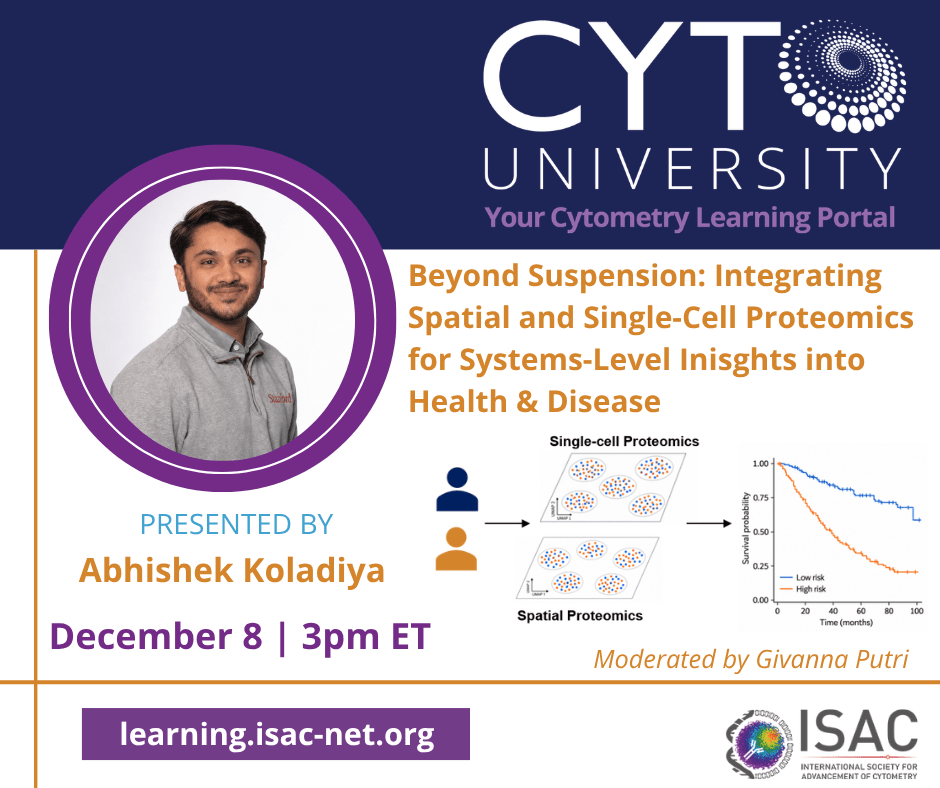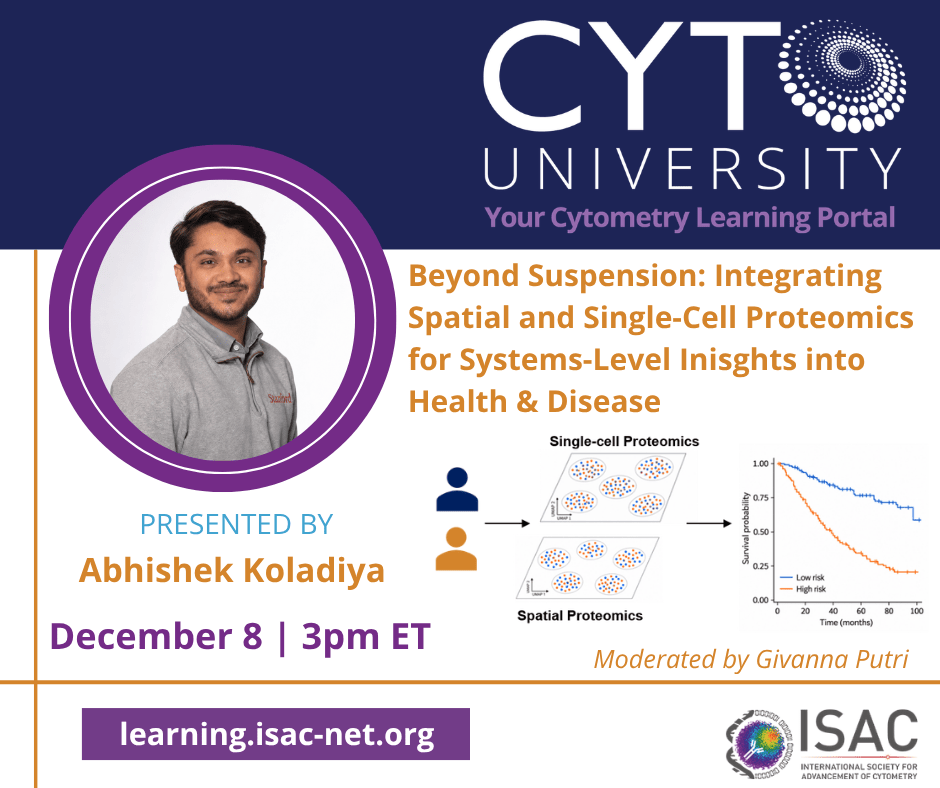
CYTO U Webinar: Beyond Suspension: Integrating Spatial and Single-Cell Proteomics for Systems-Level Insights into Health & Disease | Abhishek Koladiya
Tuesday, December 8, 2026 (3:00 PM - 4:00 PM) (EST)
Description
Learn More & Register: ISAC Learning: Beyond Suspension: Integrating Spatial and Single-Cell Proteomics for Systems-Level Insights into Health & Disease
THE SPEAKER
Abhishek Koladiya is a postdoctoral fellow at Stanford University. He completed his PhD in Cell and Developmental Biology at Charles University in Prague. His research focuses on developing computational and multi-omics approaches for single-cell and spatial biology, with applications in cancer, immunology, hematology, and precision medicine. He has contributed to several open-source computational tools, including EmbedSOM and tidyTOF, and more recently developed CellFuse, a deep-learning framework for integrating single-cell suspension and spatial proteomics data. He is a member of ISAC's Leadership Development Program Marylou Ingram Scholars track and has also received recognition from the American Society of Hematology and the Czech Society of Cytometry.
WEBINAR SUMMARY
Single-cell and spatial proteomic technologies provide complementary views of cellular identity, function, and tissue organization, but integrating these data across platforms remains a major computational challenge. Most existing integration approaches were developed for transcriptomic data and rely on large numbers of shared features, making them less suitable for lower-dimensional antibody-based measurements. In this webinar, I will discuss strategies for integrating suspension and spatial proteomics data and introduce CellFuse, a deep learning–based framework designed to connect high-dimensional cytometry, CITE-seq, and spatial proteomics datasets. CellFuse uses supervised contrastive learning to construct a shared representation across modalities, enabling cross-platform cell-type prediction, label transfer, and identification of rare cellular populations. Using examples from peripheral blood, bone marrow, lymphoma, and solid tumors, I will highlight how multimodal integration can reveal disease-associated cell states, reconstruct tissue microenvironments, and uncover interactions between malignant, immune, and stromal populations. These approaches demonstrate how connecting cytometry modalities can provide systems-level insights into cellular organization across health and disease.
LEARNING OUTCOMES
By the end of this webinar, participants will be able to: 1) Describe the key challenges in integrating suspension-based and spatial proteomics datasets across cytometry platforms. 2) Explain how multimodal integration approaches such as CellFuse can create shared representations across high-dimensional cytometry, CITE-seq, and spatial proteomics data. 3) Recognize how integrated single-cell and spatial analyses can identify rare cell populations, disease-associated cell states, and tissue microenvironmental interactions. 4) Evaluate how multimodal cytometry can be applied to generate systems-level insights into health, disease, and treatment response.
WHO SHOULD ATTEND:
Clinical Cytometrists, Computational Biologists/Bioinformaticians, Data Analysts, Imaging Cytometrists, Industry Scientists (vendor-agnostic, tool developers, method innovators), Research Scientists, Shared Resource Laboratory (SRL) Managers, Trainees (graduate students, postdocs, early-career researchers), Translational Immunologists
Images